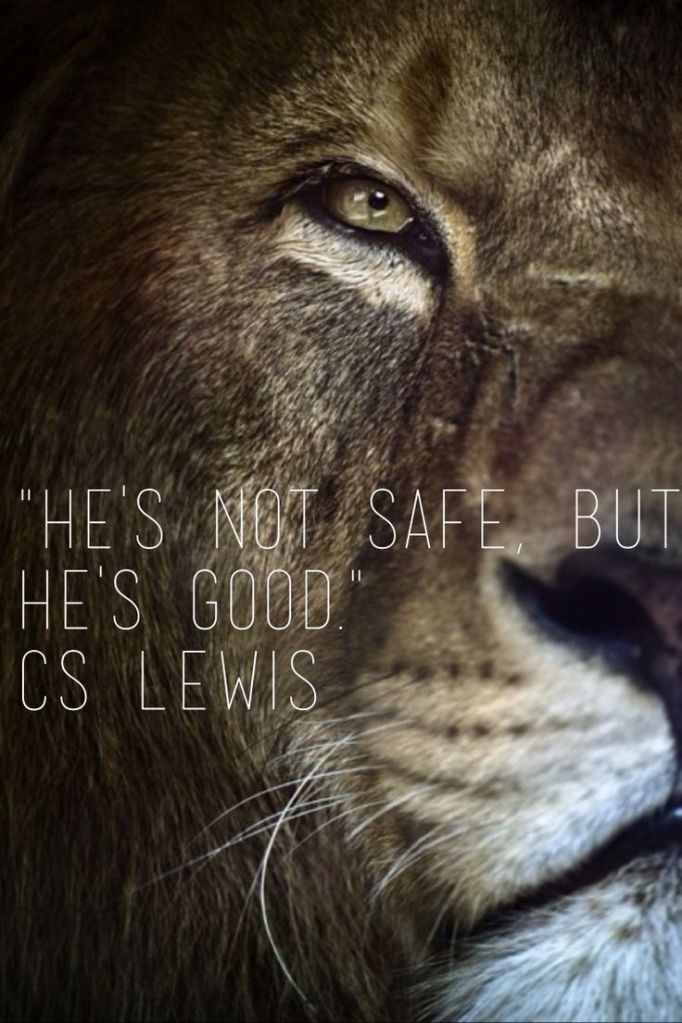
C.S. Lewis gave us one of the best descriptions of God in his book, The Lion, The Witch, and The Wardrobe. When the children enter the world of Narnia, they are told of the great Aslan. Upon his description, Susan states, “Well, he doesn’t sound very safe” (My paraphrase ). Mr. Beaver replies, “Safe? Who said anything about safe? ‘Course he isn’t safe. But he’s good.” Today’s churches teach that God is “safe.” Not only is this false doctrine, it has created a false religion within Christianity. Nowhere in the Word of God does it say that God is safe. Instead, it says that we should fear God above all things.
The Bible teaches that God is love. That doesn’t mean God stands with arms wide open, accepting everyone. On the contrary, He stands with arms wide open, ready to welcome those who accept Him. However, anyone who accepts Him must deny themselves and repent of their sins. God is love means that He will forgive us our sins even though we did nothing to deserve His forgiveness. It does not mean He will accept us while we continue in our sin. Unless there is repentance, there is no salvation.

“Well, how then does this show that God is love?” Love works in many ways. God is love means He is willing to see past our sins when we acknowledge our sins and repent. God allows humanity to live freely. He does not control, manipulate, or expect our allegiance. He asks for it, but He allows us to choose to whom we assign our devotion. As the Apostle John wrote concerning Jesus, “Here I am! I stand at the door and knock. If anyone hears my voice and opens the door, I will come in and eat with that person, and they with me” (Revelation 3:20). It is up to us to open the door. He will never force himself in.

Jesus stated this: “Not everyone who says to me, ‘Lord, Lord,’ will enter the kingdom of heaven, but only the one who does the will of my Father who is in heaven. Many will say to me on that day, ‘Lord, Lord, did we not prophesy in your name and in your name drive out demons and in your name perform many miracles?’ Then I will tell them plainly, ‘I never knew you. Away from me, you evildoers!'” (Matthew 7:21-23). Why is this not taught in today’s churches? Because it doesn’t fit the narrative of an all-accepting God. Here’s the truth: unless we repent of our sins and have a heart of repentance, there is no room in the kingdom for us.
New Age Christianity teaches that God is all loving and accepting. It teaches that it doesn’t matter who you are, how you identify, or what you do; God loves and accepts you. This is a heretical doctrine that is not supported by scripture. God does love you, but He does not and will not accept you while living in sin. God can have nothing to do with sin. “Isn’t that why Jesus died on the cross?” Yes, but the blood of Jesus does not give us a pass to continue to live in sin. The blood of Jesus covers a multitude of sins, but unless there is repentance of sin, there is no hope for the sinner.

As mentioned earlier, for salvation to be truly gained, one must repent of their sins. What does it mean to repent? In the New Testament, “repent” is translated from the word “metanoia,” which means “to have another mind.” In other words, one changes their opinion or purpose in regard to sin. What was once considered normality in a sinner’s life is now seen as disobedience and dishonoring to God. They then change their actions and behaviors to mimic this change of heart.
Here is a simple example: Some may see lying as not a big deal, but to God, it is dishonest and unloving. When one repents of this sin, they are acknowledging that lying is not good and goes against God’s commands. They then turn from their ways and begin to tell the truth in love. This does not mean they will never lie again, for as Jesus Christ said, “Very truly I tell you, everyone who sins is a slave to sin” (John 8:34). This is where the blood of Christ covers a multitude of sins. However, unless there is repentance of sin, there is no salvation.
An excellent example of this is David. David was considered a man after God’s own heart (Acts 13:22). However, throughout his life, David committed egregious sins against God. The most notable was his sin with Bathsheba. He was walking on top of the palace, looking out, and saw a beautiful young woman bathing. He asked his servants about the woman, and he was told that she was Uriah the Hittite’s wife, a soldier in the king’s army and was away at war. David sent his servants to bring her to his chamber so he might have his way with her. Later, Bathsheba sends a message to the king, claiming she was pregnant. Upon hearing the news, David sent word for Uriah to return home, hoping he might sleep with his wife. However, Uriah, being an honorable man, never left the king’s palace. He slept at the entrance to the palace and never went home. David then devised a new plan. He sent word to Joab, the commander of the king’s army. He told him to place Uriah at the front of the battle where the fighting was the worst, and when Uriah was surrounded in battle, to retreat and leave him there to die. Ultimately, what David did “displeased the Lord” (2 Samuel 11:1-27).
In one story, David, the man who was considered a man after God’s own heart, lusted, committed adultery, lied, and committed murder. Talk about a rap sheet. In the end, the Lord was greatly displeased with David. As with all sin, a great price had to be paid. Through the prophet Nathan, the Lord told David of all the egregious sins he had committed and the consequences of his choices. Once David heard all that Nathan had to say, David exclaimed, “I have sinned against the Lord” (2 Samuel 12:13). Nathan told David that his sins were forgiven. Still, the child that Bathsheba bore would surely die. David’s response to his sin and the prophecy of the death of the child:
“David pleaded with God for the child. He fasted and spent the nights lying in sackcloth on the ground. The elders of his household stood beside him to get him up from the ground, but he refused, and he would not eat any food with them. On the seventh day, the child died. David’s attendants were afraid to tell him that the child was dead, for they thought, “While the child was still living, he wouldn’t listen to us when we spoke to him. How can we now tell him the child is dead? He may do something desperate.” David noticed that his attendants were whispering among themselves, and he realized the child was dead. “Is the child dead?” he asked. “Yes,” they replied, “he is dead.” Then David got up from the ground. After washing, putting on lotions, and changing his clothes, he went into the house of the Lord and worshiped. Then he went to his own house, and at his request they served him food, and he ate” (2 Samuel 12:16-20).
David pleaded to God for the child’s life. He lay on the ground for seven days, neither eating nor drinking. He stayed there until he got news that the child had died. After hearing the news, he got up, cleaned himself, and worshiped God at the temple. This is what repentance looks like. David didn’t blame God for the child’s death. He didn’t get angry that God did not hear his cries for mercy. Instead, he accepted the consequences and worshiped God. He chose to see the error of his ways, took responsibility, and changed his mind.
This wasn’t the only time David committed sins against the Lord. Later in his life, David committed another sin against the Lord by taking a census of all the fighting men in Israel. This was a sin because God told the Israelites that a census should never be taken but that their trust should remain in YHWH and not in the numbers within the tribes. After committing this sin, scripture says, “David was conscience-stricken after he had counted the fighting men, and he said to the Lord, “I have sinned greatly in what I have done. Now, Lord, I beg you, take away the guilt of your servant. I have done a very foolish thing” (2 Samuel 24:10). Again, David repents by seeing the error of his ways. He changed his mind about what he had done. Before, he didn’t see anything wrong in what he had done. Later, however, his conscience got the better of him, and he saw that what he had done was a disgrace toward God. Again, David’s choices came with a price. Many died because of David’s choices. Why? Because sin always comes with a price – usually death.
Here’s the bottom line, God desires to have a relationship with all of us. He wants us to trust Him and live completely obedient to Him. He knows we are imperfect and are slaves to sin. This is why the life of Jesus Christ was so important. Through the blood of Jesus, we have freedom from our sins. However, unless we repent of our sins, there is no salvation from our slavery. The God of the universe does not accept sin. He accepts a heart of repentance. To say that God loves you and accepts you even though you choose to live a life completely void of God’s commands is a false doctrine and teaching. God loves the sinner but hates the sin. Unless the sinner acknowledges their sin and repents of their ways, there is no hope for them. This is the gospel Truth.
 Selfless Leadership Is Purposeful Leadership