How’s Your Character Doing?

Leadership is a way of life. We don’t need to be in a high level position or hold some fancy title to be a leader. All we need to do is live a life that exudes leadership qualities. There are many qualities that define a great leader, and each quality points back to one thing – our character. Great leadership qualities include learning to listen before we speak, being humble, serving others without looking to be served ourselves, admitting our faults and failures, putting others before ourselves, leading with strength and courage when others flee with fear, and many others. All of these qualities are a direct representation of our character. So I have a question for you – How’s your character doing?

I will be the first to admit that I do not show leadership qualities 100% of the time. There are a couple of reasons for this: 1. I am a constant work in progress and will always make mistakes, but I will never quit trying to improve and be better, 2. I struggle with some leadership qualities, and I am working on becoming better. Even though I might make mistakes and struggle in showing certain leadership qualities, I will never stop trying to become better.

The other day I had a conversation with my nine year old daughter about failure. She came to me and said, “Dad, I failed at writing today in school.” I asked her what she meant, and she said, “I couldn’t figure out the three things a sentence needs.” I asked her if she stopped trying to understand, and she said, “No.” I told her that she didn’t fail; she only made mistakes, which is normal when we are learning. She then looked at me with a puzzled look, and I explained, “You only fail when you stop trying. If you make a mistake and try to correct that mistake, then you didn’t fail. All you did was make a mistake.” 

You’re probably sitting there going, “That’s a nice story and all, but what does this have to do with my character?” No one is perfect, and we all make mistakes. Humanity seems to see mistakes as failures and many times chooses to stop trying to improve themselves. When we struggle with character qualities, we have two options – stop trying to become better and fail at building a strong character, or continue to work on those qualities even after we make mistakes. Our character is what will last when we are gone. Our title and position in life does not matter. What matters is who we are on a day to day basis, and it’s our character that determines the kind of person we are.

I may be altruistic in saying this, but I don’t believe people have an innate desire to be disrespectful, arrogant, prideful “A” holes. I believe people want to do good and be good. I believe people have a desire, deep down, to be better human beings. The problem is that our society glorifies behavior that promotes bad character traits. When all we see is the glorification of negative, poor character traits, then we begin to consider those traits as normal. In reality, these “normal” traits are anything but good. 

There is an old adage, “Garbage in, garbage out.” It took me until my early 20’s to understand what this adage really meant. The more negativity, false doctrine, and lies we allow to permeate our existence, the more we become the very things we know are wrong. If we allow for bad character traits to seep into our being, then we slowly become, and normalize, what we know is poor character qualities. To mitigate this problem, we must be in a constant state of reflection and learning. We must admit our faults and mistakes and do what is needed to become better human beings. Our poor choices and character qualities are nobody’s fault but our own. 

So, how’s your character doing? I challenge you to take a deep, hard look at yourself and determine what character qualities you need to change and work on. And don’t forget, you only fail when you stop trying.

As always, stay humble and serve well!

Challenge Yourself

Challenges are never easy. Thus the reason they are called challenges. But we seem to allow challenges to own us instead of us owning them. What I mean to say is that we tend to give up, stop trying, make excuses, etc. We tend to go into a challenge with a winning mindset, but once it becomes hard, tiresome, or painful, we quit. Challenges are something that pushes us beyond what we think our limits are. Challenges push us outside of our comfort zone and force us to become more or better than we were. Challenges can be inspiring, and unless we stay focused, push ourselves, and stop making excuses, every challenge we go through will own us.

Throughout the months of August and September, I found myself being challenged both mentally and physically. What you are about to read is a summary of my challenges and the lessons I learned as I pushed myself through each challenge.  

On a hot August afternoon, I was sitting in my chair in the living room scrolling through my social media feed, wasting time and my life, and came across the Great Cycle Challenge USA. This challenge was to bike ride a specific number of miles throughout the month of September and meet a personal donation goal all in the name of fighting children’s cancer. When I read about the cause and what I was being challenged to do, I couldn’t help but feel a desire to get involved. I clicked on the link, set up a profile, and set my miles at 250. I was given choices of 100, 200, 350, or 500 miles. I felt 200 was too little, and 350 seemed like a lot for my first time, so I chose to set my miles at 250. I then was asked to set a donation amount. I was again given a bunch of choices for how much I wanted to raise, and I chose to raise $1000; mind you, I have never done any formal fundraising in my life.

At the same time that I was setting up my profile for the Great Cycle Challenge USA, an email flew into my inbox that said Elmore County Rescue was hiring. As someone who has been in emergency services before, the want, passion, and desire to help and be part of something bigger than yourself never goes away. As soon as I read the email, I was quick to get online and fill out the application. At the interview, I was told that I would have to pass a physical fitness test, to which I replied, “No problem!”; and then I was told there would be a mile run where I had to run a mile in under 12 minutes. Now for those of you who just said, “Pshh, a mile in 12 minutes? That’s nothing.” You’re probably right, but I’m an out of shape, 300+ pound guy that hates running. However, this was something that I wanted, so I said, “Challenge accepted.”

In the past, I would start a challenge and fizzle out within a few weeks, but for some reason, these two challenges were different. I saw these challenges as personal goals, not only for the cause, but for myself. I wanted to see myself succeed. I figured that 10 miles of biking per day would get me to my goal, and give me 5 days I could miss. I started getting warmed up for the long distance rides in august by biking 7 to 8 miles a day. On top of the riding, I started training for the mile run. I only got 4 days of running due to the air quality that we were having. I was hoping that my biking would also help in my running preparation.

For the last two weeks of August, my body hated me. My legs hurt, I hurt, and I realized how out of shape and unhealthy I really was. My 1 mile run came at the end of August, and as I mentioned before, I was only able to train for 4 days. I did get a mile in each of those 4 days, however each day was well past the 12 minute mark. I took a day off of riding before my mile run to let my legs have some down time. The day of the physical fitness test came and before the run I had to do a 100 foot 165 pound dummy drag, a 10 yard farmer carry with 60+ pounds in each hand, four 200 pound tire flips, and 4 minutes of CPR compressions (2 minutes on, a 2 minute break, and another 2 minutes on). Finally, we finished with a 1 mile run. 

I started the run pretty well and quickly found myself at the back of the pack. I would run as far as I could, fast walk to catch my breath, and then run some more. The rescue team had one of their guys run with us. Sadly, because I was in the back of the pack, he had to stay with me. I felt so bad and embarrassed for being the slowest. I’m pretty sure I apologized for being so slow ten or more times. Benny, the rescue guy running with me, kept encouraging me, telling me my time and pace, and gave me the confidence to keep going. 

I got to about the ¾ of a mile mark, and my body was spent. I was walking more and was feeling the burn in my legs, shins, and lungs. I asked Benny what my current pace time was, and he told me 11:58. I wanted under 12 minutes so badly. I kicked it into gear again a couple hundred more feet and quickly found myself back to walking. Benny said, “Good job. You just knocked off 10 seconds. You are now at an 11:48 pace.” The problem was I still had a ways to go. I kept walking, trying to catch my breath. Benny then said, “You’re back to 11:58.” I asked him where I needed to get to, and he pointed to a truck in a parking lot a good 1000 feet away. I was gassed, but I wanted to make time. I yelled at myself and told myself to suck it up and get it done. With that, I put on the afterburners and didn’t quit running until I passed the truck. I passed the truck at 11:56; four seconds under time. Challenge one complete.

Now it was time for my month long bike riding. September 1st came and I hopped on the bike and rode 10 miles. I did another 10 miles the next day and took the following two days off. For the first full week of September, I rode 5 days for a total of 51 miles. I was feeling proud of myself, and I felt my body acclimating to the rides. That first week got me just under 200 miles. I had 199 miles to go. The second week was a lot of the same, until the day of the 19th. I wanted to push myself. It was my first long ride, and I hit 20 miles in one ride. Not only did I feel great afterward, I was ecstatic for doing something I didn’t think I was able to do. The final week of September was approaching and I still had over 60 miles to ride. I decided to push myself for the last few days and get it done. On Sunday the 26th, I rode 25 miles – 10 in the morning and 15 in the afternoon. This ride put my total at 255 miles with 4 days to spare. 

On top of the miles challenge, I had to meet my donation challenge. I took to Facebook to start posting my progress. I started with a video and a summary of what I was doing. As I rode, I would post updates on the miles I rode, and included a link for people to donate to the cause. I was honored and humbled by the number of people who chose to donate and the amounts being donated. My goal was to reach $1000. Half way through the month of September, I met my goal. The total donations that I received put me over my goal by $300. If it wasn’t for the consistency, updates, and investing in the cause, I don’t think I would have met my goal. If we don’t invest time and energy into what we are trying to achieve, we will never achieve it.

Both challenges pushed me, but they also gave me purpose. I was seeing results and was excited to keep going. Yes, it was hard. Yes, I hurt for a lot of those days. But overall, I was making progress and making myself better. I was feeling good mentally and physically. There were times I wanted to quit, but I had people cheering me on. My wife would give me words of encouragement, my best friend wouldn’t let me make excuses, and my now rescue teammate ran alongside me and kept pushing me to keep going. What this has shown me is the importance and value of having people in your life who will encourage you, push you, and hold you accountable. We fail on our own, but when we have people speaking into our lives and pushing us to be better, we don’t have an excuse to quit. 

In both challenges, I wanted to see progress. I wanted to see change overnight. In reality, progress doesn’t work like that. Progress is made when we take one step after another, or one pedal after another. Progress can only be made through discipline and consistency. If we don’t have these two qualities in our life, we will never see progress. Also, progress is not fast. It takes time. Instead of focusing on the desire for progress, we need to focus on the day to day consistency, and when we do that, progress will come on its own.

I feel the biggest lesson I learned through these two challenges is that nothing will change unless I do. For 38 years, I have always had good intentions of wanting to be healthy, to push myself, and to challenge my abilities. But that’s just it, it was nothing but intention. It wasn’t until I determined within myself to do what I said I wanted to do that something changed. I had to change my actions, my behaviors, and most of all, my mindset. I had to get into a routine and stop making excuses. I had to put in the work. And I will be honest, for the first two weeks, it sucked. I was hurting, but I was also making progress. I was starting to feel good mentally and physically. In the end, I feel much more confident in my abilities, I feel proud of myself for seeing these challenges through, and I can hold my head up high knowing that I conquered the challenges; I owned the challenges. I can make excuses all day long, but excuses will only get me to an early grave.

I want to encourage you to challenge yourself. Don’t live life with good intentions. Turn those intentions into action. Push yourself to be more. You will want to quit, but I’m telling you, don’t! Keep riding through the storm. It’s going to hurt, and when it does, you need to negotiate with yourself to find more strength. Don’t give up because you don’t see results right away. Results come in time; you just need to keep putting one foot in front of the other. Surround yourself with people who will hold you accountable and push you to keep going when you want to give up. Progress only comes if we keep moving forward. Stay the course, don’t quit, be disciplined and consistent, and when you do all these things, you will be able to stand tall knowing that you owned the challenge.

As always, stay humble and serve well!

Are You Worth Imitating?

The older I get, the more aware I have become of the responsibilities I have been given as I age. The past two years have taught me more than I thought possible. I know many are sick and tired of Covid, no pun intended, but for me, I have seen it as an opportunity to grow mentally, spiritually, and emotionally. I have read more books these past two years than I have my entire life. I have begun writing a lot more. I have started to take my health more seriously. I have pushed myself to become better. Through it all, I am left wondering, “Am I someone worth imitating?”

I am a firm believer that leadership is not a title or position one holds, but rather a way of life in which we conduct ourselves. I also believe that it is a leader’s responsibility to raise up other leaders. When I look at my life and take stock in all of the people I influence on a daily basis, it becomes quite clear that my actions, words, and deeds have a more significant impact than I think. Does what I say, what I do, how I respond promote a way of life worth imitating? I would like to think so, but as I sit here reflecting on past social media posts, conversations I have had with close friends, and even my own parenting, I can’t help but feel a sense of shame knowing that I have missed the mark on many occasions.

I long to live a life that people want to imitate. I want to live a legacy that people will want to be a part of. I want to lead in a way that encourages others to do what is right, live with integrity, be humble, and most importantly, live a selfless life. However, all of that starts with me. I must be the example I want others to follow. I must live in the way I want others to live. I must be a person worth imitating. 

I have made many mistakes, and will probably make more, as I am a continual work in progress. However, this is where humility comes in. I will miss the mark, and I will make mistakes, but I must have a heart and spirit of repentance. I must strive to be better. I must humble myself, admit my faults, and work on becoming a better man, husband, father, friend, and leader, than I was yesterday. 

I need to ask, “What kind of human beings do I want my children, my wife, my friends, and my colleagues to be?” I want my children to grow up doing what is right, having a heart of service, and to be humble in their attitude and actions. I want my wife to do whatever it takes to make our relationship work, be willing to follow me because she knows I have her best intentions at heart, and I want her to be loving and trustworthy. I want my friends to be loyal, trustworthy, and honest. I want them to be respectful and encouraging. I want my colleagues to work hard, be positive, and do what’s best for students.

This sounds like a pretty tall order, but the truth of the matter is that all of that depends on me. What I want from other people needs to be what I do on a daily basis. I need to live a life worth following, and I must hold myself accountable first. It’s more than treating others the way I want to be treated. It’s more about living a life I want others to live. The responsibility lies with me. I must purpose within myself to be an individual, a leader who lives a life worth imitating.

As always, stay humble and serve well!

Leadersheep

What makes a great leader? This question has multiple answers depending on who you talk to, what podcast you listen to, or what books you read. 

Joel Farar, from Farar Law Group, says, “Great leaders make the hard choice, and self-sacrifice in order to enhance the lives of others around them.” 

Mike Dan, from SMS Marketing, says, “A great leader does not lead by forcing people to follow. Instead, a great leader motivates people. They encourage others to follow them. They also lead by example, which few leaders do today.” 

Jake Rheude, Director of Business Development for Red Stag Fulfillment, says, “Great leaders are incredibly ambitious, but never for themselves. Rather, they are ambitious for the company and possess the will to do whatever is necessary in service of this greater cause.” 

These are only a few examples that I found from a quick search about what makes a great leader. Can you see the similarities in each of these quotes? A great leader leads with others in mind and not themselves. There are, of course, many other examples, definitions, and opinions of what makes a great leader. However, there is one characteristic that I have found to be fluid throughout all discussions about the qualities and characteristics of a great leader, and that characteristic is courage

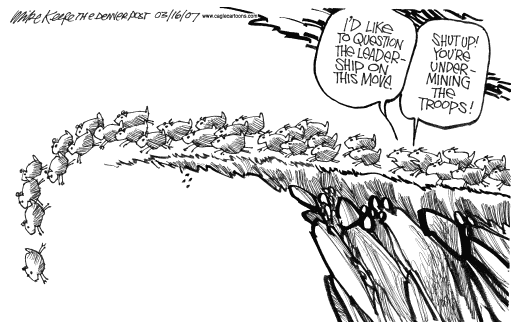
A leader who does not have courage is not a leader, but rather another sheep in the herd. We have all seen the picture of the one sheep moving in the opposite direction of all the other sheep, as all the other sheep keep mindlessly wandering toward the cliff of doom. Instead of following the crowd and doing what everyone else is doing, a strong leader has the courage to turn around and do what’s best for their team. They will walk against the current to stand for what is right. They will refuse to be bullied, shamed, or even cancelled into doing something they do not feel is not morally or ethically acceptable. 

There is a significant difference between “leadership” and “leadersheep”. One stands for what is right with courage and tenacity. They don’t back down from a fight and can’t be bullied to follow. They stand for their team and will make whatever sacrifices are needed to ensure their team succeeds. Leadership cannot be bought, cannot be threatened, and cannot be pressured into doing something they know is immoral, unethical, and against what they know is best for their team. Leadership thinks for themselves and has courage to stand under pressure when everyone else falls. These are the people who can spot the wolves in sheep’s clothing. 

Leadersheep are those who are run by money, pressure, threats, and pride. Their focus is on themselves and doing what’s right for them. They don’t look out for the team. They don’t stand in the way of tyranny, but succumb to it and allow it to destroy their people and their company. Leadersheep lead out of fear. They care more about following the masses than doing what is right. Their pride is more important to them than their character or integrity. They fall under pressure and will do what they are told in fear of losing their title, their place in the company, or the money they make. They don’t care what happens to their team as long as they are taken care of. These are the sheep that march toward the cliff of doom. These are the people who will be destroyed by the wolves in sheep’s clothing.

I have seen both leadership and leadersheep. I have found that I have more respect for those who take on the role of leadership than I do for those who choose to be leadersheep. I have seen men and women in leadership stand for what is right, fight against immoral and unethical acts, and in the end lose their title. However, they left with their heads held high; knowing that they did not compromise their character or integrity.

Leadership takes courage. Since we are all in a position of leadership, let us lead with courage, stand for what is right, fight against immorality and unethical acts, and most of all, hold our heads high knowing we will NEVER sacrifice our character and integrity to follow the sheep.

As always, stay humble and serve well!

When Does Our Opinion Matter?

The French Enlightenment writer, historian, and philosopher, Voltaire, once said, “Opinion has caused more trouble on this little earth than plagues or earthquakes.” Former frontman of Nirvana, Kurt Cobain, said, “We have no right to express an opinion until we know all of the answers.” This then begs the question, “When does our opinion matter?”. 

Let me pause for a second and remind all of you that my blog focuses on subjects that I contemplate, wrestle with, and am growing through. I have been known to state an opinion or two on social media platforms. What you will read are personal thoughts and reflections about the question stated in the title. This blog then is a dichotomy, as I am stating an opinion about when our opinions matter. Okay, back to the topic at hand.

With platforms like Twitter, Facebook, Instagram, TikTok, etc., opinions are freely expressed at any time from anywhere. I believe Franklin D. Roosevelt said it best when he said, “There are as many opinions as there are experts.” Opinions seem to be as numerous as the stars, but the problem is that opinions are just that, opinion. If you Google the definition of “opinion”, you will read, “a view or judgment formed about something, not necessarily based on fact or knowledge.” I think the last part of this definition should be read again, “NOT necessarily based on fact or knowledge.” But for some reason, we seem to take opinion as fact, or we believe that our opinions ARE fact. Because of this thinking, we are living in a world where opinions outweigh facts.

We also seem to put a lot of weight on other people’s opinions. Chinese philosopher and writer, Lao Tzu, said, “Care about people’s approval, and you will always be their prisoner.” Why do we give so much authority to other people’s opinions? Should their opinions matter? I think Facebook is a perfect example of people allowing other people’s opinions to have authority over their attitude and actions. It usually starts with someone posting an opinion that “offends” someone, and the offended person responds by throwing their opinion’s back. This then leads to a tirade on social media that has done nothing good and has shown more ignorance than understanding. Why do we let people’s opinions control our actions and reactions?

There is a saying that goes, “If I want your opinion, I’ll ask for it.” Even though this is usually used in a derogatory manner, I believe it holds the key to when our opinions matter. As we all are aware, everyone has an opinion about everything. For example, everyone has opinions on Covid, vaccines, and mask mandates. Everyone has opinions on the current and past presidents. Everyone has opinions on religion, politics, etc. What’s even more is that people from all sides seem to share their opinion freely about these topics on social media websites. Some back their opinion up with “factual evidence”, while others seem to just share their opinion as if their opinions are fact. Either way, opinions are being shared, but do they matter?

I have learned that our opinion matters only when we are asked for it, or when we are standing for what we believe is right. However, our opinion doesn’t matter if we choose to speak our thoughts without having factual evidence to support our opinion. If we share our opinion because we need to share it, then we are showing ourselves to be ignorant and pompous. American essayist, lecturer, and philosopher, Ralph Waldo Emerson, said it best: “People do not seem to realize that their opinion of the world is also a confession of character.”

Opinions are nothing more than emotional responses to what is happening around us. An opinion does not make us correct, our opinions do not make us all-knowing, and unless we construct our opinions on factual evidence and truth, our opinions show our ignorance more than anything else. Our opinions really don’t matter. We need to learn to close our mouths and open our ears. We need to stop thinking that our opinions matter as much as we think they do. We need to stop sowing discord and start learning how to listen, care, and attempt to understand one another. Does this mean we will always agree? Absolutely not. However, we need to learn to have respectful, knowledgeable, and open minded conversations. We need to stop throwing around our opinion like it’s God’s truth. We need to realize that our opinion doesn’t really matter all that much unless someone asks us to share it. Of course, all of this is just my opinion.

As always, stay humble and serve well!

Have We Forgotten?

It was just before seven o’clock in the morning. I was getting ready for school in my second week of my senior year. I was gathering my books and my papers and placing them into my backpack when my father came bursting through the front door. This took me by surprise, as my father never came home that early. He rushed through the front door and into the family room. I heard the TV go on. Curious, I went out to see what all the fuss was about. As I came around the corner, I looked at the TV and saw an airplane smash into the South Tower. My father and I stood speechless. I asked if it was real, and my father assured me that it was. After a few moments standing in silence, my dad told me to get to school. 

I jumped in my car and headed to school. When I entered the classroom, there was a TV on, and everyone was sitting, watching the news. During the time it took me to get to school, the Pentagon had been struck. I quietly sat down and watched the news with my classmates. As we watched, the South Tower collapsed. Twenty minutes later, the North Tower collapsed. All I remember is seeing the dust, smoke, debris, and hellish screams blaring through the TV. I remember watching people running for their lives in absolute horror. I remember asking myself why this was happening. I remember sitting in absolute shock watching it all unfold. 

September 11th will mark the 20th anniversary of 9/11. I have to be honest, it was 12 years after 9/11 that everything that transpired on that fateful day became real to me. In 2013, I became a member of the Mountain Home Fire Department. It was during my time as a firefighter that I learned what 9/11 really meant. I learned about brotherhood and what 343 stood for. I learned that men and women in emergency services have a bond like no other. I learned what bravery, courage, and dedication looked like. I learned what the human spirit was truly capable of.

Along with being a firefighter, I was also a teacher. That meant I got the opportunity to explore, research, and teach students about 9/11. After doing the research and learning more and more about 9/11, I started gaining a special kind of respect for all those involved on that horrific day. Nearly 3,000 people lost their lives in a matter of 14 hours. Without any hesitation, firefighters and police officers rushed into buildings and started climbing over 100 stories to save complete strangers from fire and entrapment; not knowing that those buildings would soon come crashing down upon them. Complete strangers were helping other strangers escape, find safety, or just sitting, holding each other and crying. September 11th was a horrific incident, but it showed a side of humanity that was once forgotten, and I believe has become forgotten once again.

Twenty years later, we are at each other’s throats. We are divided farther apart than we have ever been. You can blame it on whatever you want; politics, media, whathaveyou, but the truth is, we all have a choice. On September 11th, 2001, there was no black or white, male or female, Christian or Atheist, there was humanity plain and simple. In a time of tragedy and loss, nothing mattered except our fellow neighbor. It seems that we have forgotten what it means to love our neighbor. We have lost sight of what it means to support, help, and sacrifice for each other. If we are not careful, we will end up destroying each other. 

We post every year, “We Will Never Forget!”, but I fear we already have. We have forgotten what it means to look out for each other. We have forgotten how to help selflessly, and make sacrifices for those around us. We have forgotten that we are all equal, and no one is better than another. We have forgotten that our neighbors are not our enemies, and how to look past our differences. But most of all, we have forgotten how to love each other.

On the 20th anniversary of 9/11, I pray that we start to remember what it means to be unified, what it means to stand together, what it means to love our neighbors, and most importantly, what it means to live selflessly. I ask that you break down your wall of pride and remember the power of humility. I ask that you remove your selfishness and become selfless. I ask that you stop seeing your neighbor as an enemy, but rather a brother, sister, and friend. Let us never forget that we are all in this together, and when it comes time to run into a “burning building” for our neighbors, we would do it without a second thought in hopes to save the lives inside.

As always, stay humble and serve well!

The Death Sentence

At first they just mocked him and spoke poorly about him, but after a while, they did everything in their power to put him to death. It started with jeering, mocking, and hateful speech. And instead of getting a response of anger, their actions were met with patience and grace. When they didn’t get the reaction they wanted, they did everything in their power to put hands on him and accuse him of blasphemy. When they finally got what they wanted, their jeers and mocking escalated to punching and physical violence. Still not getting the reaction they wanted, they cried for him to be put to death. 

They took him before the heads of government and demanded they condemn him to death. In fact, they demanded that a murderer be released and this man take his place. In hope to save a man who the heads of government found no guilt and to appease the mob seeking his death, they sentenced him to public flogging. He was whipped 39 times with a cat o‘ nine tails. The man took his lashings without cursing the mob or the people performing the act. 

After his 39 lashings, the mob wanted more. The heads of government finally relented and acquiesced to the mob’s cries for death. At this point, the man was bleeding profusely. He was tired and in and out of consciousness due to blood loss. The mob demanded that the man carry his own death sentence on his back. The death sentence weighed about 165 pounds. The man barely made it 2000 feet before his body couldn’t go on. The officers in charge of carrying out this death sentence pulled a bystander out of the crowd to carry the man’s death sentence the remaining 3280 feet. During this whole time, this man was silent, never cursing or yelling out against his inhumane treatment. He was not seeking safety for himself, neither was he trying to escape his suffering. 

When they reached the destination for the execution to be performed, the bystander dropped the man’s death sentence to the ground, the officers took the bleeding and barely conscious man and threw him onto his death sentence. They stretched out his arms on each side and drove nine inch, square nails through his wrists. Then they took his feet and drove the same nails through his ankles. When all the nailing was complete, they hoisted the man’s death sentence into the air and dropped into a three foot hole. 

Once the death sentence was in place, the mob continued their jeers and mocking. They told him to save himself as he was bleeding out on his death sentence. They yelled, cursed, and verbally assaulted the man as he was taking his final breaths. Throughout all this, the man looked down from his death sentence and said, “Forgive them. For they do not know what they do.” In the midst of his suffering, he did not see anger. He did not seek retaliation. He acknowledged the people’s selfishness and anger filled blindness. He saw them as a people in need of redemption. He poured himself out and gave grace and forgiveness. 

People are bent on doing what is wrong and what is evil. This started when we, humanity, ignored and disobeyed the Living God’s command to follow and listen to Him. We decided that our way was better than the Creator’s way, and we chose to follow after our own selfish desires. After millenia of seeking selfish passions and desires, our hearts have become hardened toward the Creator God. This hardness of heart has turned humanity into a bent and broken people whose passions seek only selfish will and intent, and, at many times, will do whatever it takes to get what they want. 

Not only does humanity suffer from the veil of selfishness, we also suffer from the veil of hate. This hate that burns inside us has created a people who have little to no care for others. They are fixed on themselves and care very little about their own fellow man. Both veils have something in common; they are exactly the opposite of what the Creator of the World desires for us. These veils are the reason we have so much suffering in our world. It’s also because of these veils that we do not know how to give grace and forgiveness to each other.

Because of the veils previously mentioned, humanity has a hard time seeing past themselves. This blindness keeps us from seeing each other as broken people in need of redemption. These veils also keep us from understanding what true forgiveness really looks like. Because of this, when we suffer, we take it personally, and our reaction is to seek retaliation; the direct opposite of grace and forgiveness. Please don’t misunderstand me. I know there are people in this world who know, understand, and show true grace and forgiveness, but it is a rare commodity. Humanity is bent to seek retaliation before we give grace and forgiveness, because we have a hard time seeing past ourselves. 

I write this knowing that I too struggle with the thought of giving pure and true grace and forgiveness to those who offend or hurt me. I struggle with the desire to retaliate and wanting justice. The thought of anyone doing something to myself or my family makes my blood boil. My initial desire is to see justice served. I would want my suffering to be avenged. However, my desires for vengeance and justice would produce nothing good. This is the true definition of “Turn the other cheek.” 

We need to rip off the veils of selfishness and hate and see others for who we all are; broken people in need of redemption. This is not going to be easy, as we have been conditioned to seek selfish intent. We must look to the one who showed us what true grace and forgiveness looks like. We must stop thinking that our way is the best way and begin seeking the Way of the Creator God. We need to learn how to “turn the other cheek” and give grace and forgiveness; just as it has been given to us.

As always, stay humble and serve well! 

Be A Person Of Your Word

“Be true to your work, your word, and your friends.” 
~Henry David Thoreau~

Have you ever asked a friend for help, had them commit, and then at the last minute make an excuse for not showing up, or maybe a friend asked you for a favor and then took advantage of your time and willingness to help? Either way, how did it make you feel? What were your thoughts about your friend? My guess is you were probably frustrated, irritated maybe, or annoyed in some way because you were let down or taken advantage of. Whatever it might have been, my guess is you either learned not to ask that friend for help or you were more likely to say “No” the next time your friend asked you for some favor. Bottom line, a person who does not keep their word is someone who is not respected or trusted.

Right now, we are in the midst of an utter disaster with the administration of the United States. President Biden made the choice to pull troops out of Afghanistan. This has turned into absolute chaos, danger, and loss of life. However, it wasn’t just Biden’s fault. Military leadership stationed in Afghanistan were also to blame. Even though there were many problems that led to the debacle, one thing can be found true…we did not stand by our word to protect and ensure the safety of the citizens of Afghanistan from the horrific and terrible acts of the Taliban. Instead, we pulled out and let chaos ensue. Now, the Taliban is destroying the lives of men, women, and children all in the name of religious and political fanaticism. Now, we have lost respect and trust from the people who depended on us.

Respect is not given; it is earned. Respect is earned when we stay true to our word and make whatever sacrifices that need to be made to live up to our word. Respect is something that cannot be forced. Respect must be given if you want it in return. In fact, when you are a leader and expect respect from your team, you will likely find yourself alone with little to no respect. Demanding something from others doesn’t really go well from the person doing the demanding. Respect must be earned, and it usually takes time. When you give little encouragement and do more berating, you will lose respect from your team. When you give meaningless feedback and expect people to just “know” what needs to change, you will lose respect. However, one of the quickest ways to lose respect from your team is to speak out of both sides of your mouth. If you want respect from your team, then you must be a man or woman of your word. Don’t blow smoke. Don’t sugar coat things. Be honest, real, and transparent; and do all of this with humility and compassion.

Just like respect, trust is a quality that must be earned. If you don’t have your team’s respect, you probably don’t have their trust either. Trust must also be given in order to be trusted in return. And if you think your team can’t see through your B.S., you are a fool. Trust is not earned by saying, “Don’t worry. You can trust me.” Trust is something that must be proven. This comes by doing what you say you will do. It happens when your team knows that when you say something, you will follow through. You will show up and give 100% every time. When you say you will do whatever it takes to get your team what they need, then you won’t quit until your team has what they need. You will make the sacrifices to show your team that what you say is true and prove it through your actions. Truth comes from being a man or woman of our word.

Talk is cheap. Don’t be a cheap leader. Lead with integrity and do what you say you will do. If you can’t follow through, then be transparent and honest. Don’t make excuses, take responsibility. Humility will earn you more respect than trying to backpedal or push blame. In the end, “Be true to your work, your word, and your friends (team).”

As always, stay humble and always serve!

The Power Of The Pencil

Have you ever stopped to consider the power of a pencil? I mean, think about it. It has the power to give the user the confidence to work, knowing that a mistake can easily be corrected. It provides security knowing that nothing is permanent and can be redone at any time. It gives the user the ability to become better in what they are doing. The power of the pencil is truly something to learn from.

We go through life thinking that we are writing everything we do in permanent marker. We make decisions and choices that are chiseled onto our life path. We think that everything we do is permanently etched into who we are and we become defined by our choices. We write and write making mistakes left and right. And instead of correcting our mistakes, we keep moving forward, never reviewing what we have done to make the necessary corrections. We have missing punctuation, words that should be capitalized, and words that are misspelled. Our life seems to be a jumble of good writing mixed in with some awful mistakes.

Instead of realizing that our life is written in pencil and can be changed at any time, we continue writing our life as if we were using a permanent marker. Please don’t misunderstand me, there are decisions that have a lasting impact in our lives, but that doesn’t mean we can’t change. The original lines that were written by pencil are still on the paper, but those lines can be written over with new graphite. We might make poor choices in life, but we don’t need to continue to make those choices. We can erase the character traits that led us to those choices anytime we want. We can change our attitudes, our motives, and even our mind set. 

Not only can we change our attitude, motives and mind set, we can also correct mistakes in relationships. It’s amazing what happens when we realize that we are writing our life in a pencil and not a permanent marker when it comes to relationships. As human beings, we tend to make mistake after mistake. Those of us who are attuned to the pencil we are writing with, when we make mistakes in our relationships, we quickly turn our pencil over and make corrections when needed. We say things like, “I am sorry,” “I was wrong,” or even “I forgive you.” We seek to correct the mistake and reconcile our relationships. If you are always thinking your life is written in permanent marker, you might miss the opportunity to mend broken relationships and burning bridges, and you might write off valuable relationships in your life. 

If you think you are writing your life with a permanent marker, I encourage you to put down your marker and start using a pencil. We are not stuck in a life that is non-correctable. All we need to do is turn our pencil around and start making corrections.

Stop Sacrificing The Truth

It seems that our society has decided to disregard most forms of truth. Instead of standing for what is right and what is true, society will manipulate the truth to cater to the emotions and feelings of others. The more we choose to sacrifice the truth for others feelings and emotions, the more we approve of a reality that is nowhere near real. When reality becomes too distorted, humanity will become a people of destructive habits and society will no longer be able to properly function. 

So what is “Truth”? I consider truth as anything that has been tested and proven over time to be true. For example, the sun will rise every morning, if you jump off of a cliff, you will fall to the ground, or putting your hand on a hot stove will burn your hand. Now, these may be simple examples, but each of these have been tested and proven over time and are considered truth. Here’s another one: A biologically born male is a male and cannot be a female without a medical procedure. The same applies to a biologically born female. This is truth. 

Can truth be questioned? Absolutely. However, how we question the truth determines our willingness to accept it or not. Utterly denying the truth because we don’t like it doesn’t mean we question the truth. It just means our feelings got hurt and we are not mature enough to accept it. The proper way of questioning truth is to use the scientific method. Start with a question, research everything you can about your question, develop a hypothesis, test your hypothesis, try and prove your hypothesis wrong, draw a conclusion, and report your findings. Have others check your work for fallacies and accept what you find. PS…your feelings don’t matter when questioning the truth. To ignore truth is to give up integrity. 

Truth isn’t what we say it is. Truth is proven through testing and time. Truth doesn’t change just because we don’t like it. In other words, truth doesn’t change based on how we feel about it. So what happens when we cater to the feelings of others rather than speak and hold to truth? The answer is we help develop a false sense of reality which in turn leads to destructive habits. Psychologist Dr. Victoria Dunckley said, “Seeking artificial validation not only results in addictive, destructive behaviors, it also displaces the very experiences that would otherwise offer us authentic validation.” Bottom line, when we allow feelings to trump truth, we blatantly encourage delusional living.

Truth should NEVER be sacrificed to appease the false reality of others. With a society struggling with multiple forms of mental health, all we do when we disregard truth for feelings is continue the problems we have with mental health disorders within our society.  If we truly care about other people, we should compassionately and respectfully speak the truth no matter what; especially if we are working with youth. Anyone who ignores truth and facts to appease the feelings of others is hindering more than helping. Ladies and Gentlemen, truth is not always easy to swallow, but that doesn’t mean we ignore it. 

No matter who you are, who you work with, or what you do, do NOT sacrifice the truth to appease the feelings of others. Stand strong, be honest, be compassionate, and live with integrity. And as always…stay humble and serve well.